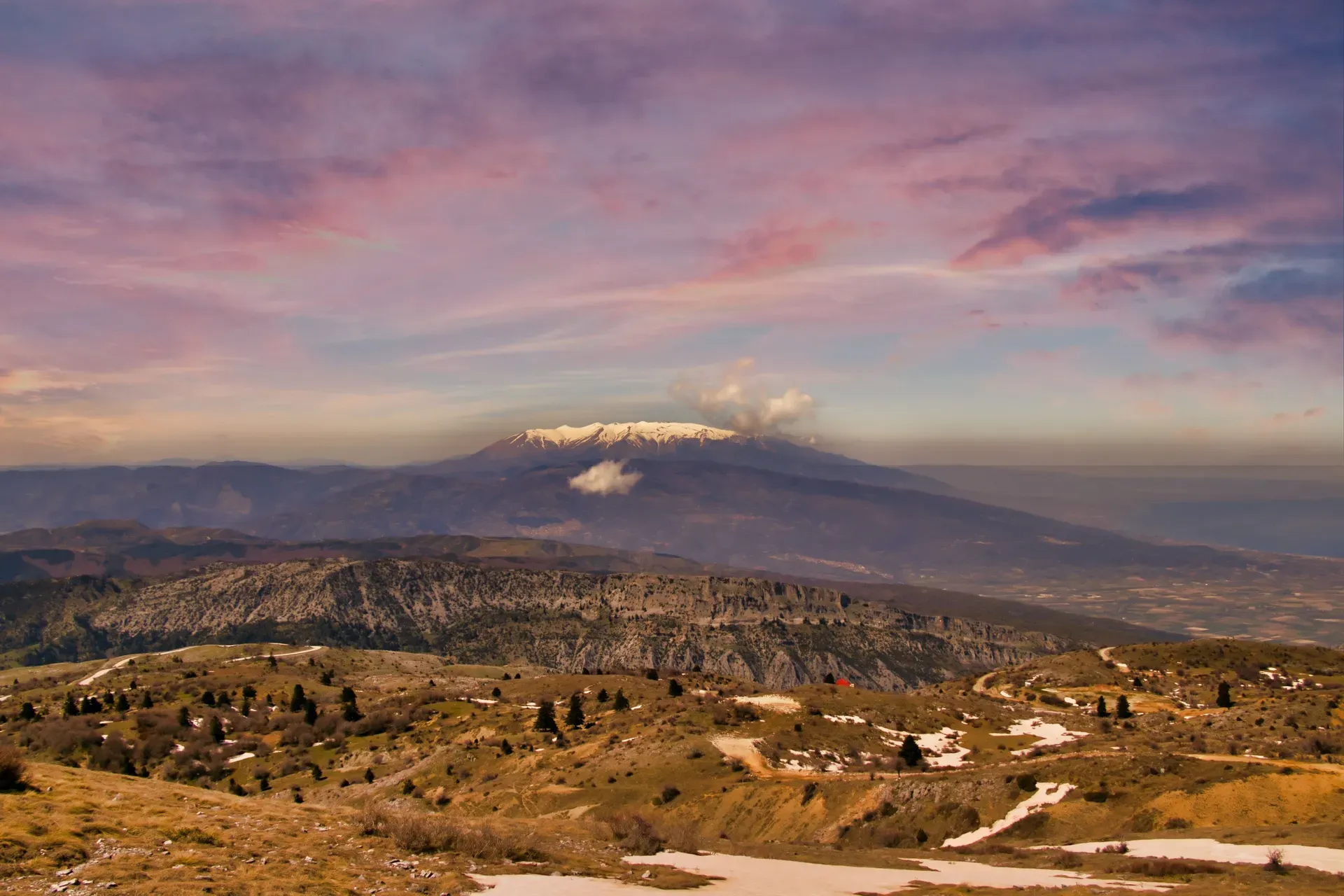
Mount Olympus rises off the Aegean coast of northern Greece to 2,917 m at Mytikas, the country's highest summit. It's the mythological home of the twelve Olympian gods, a national park since 1938 and a UNESCO World Heritage site since 2026.
Mount Olympus is the highest mountain in Greece — a single massif of 52 peaks and deep gorges that climbs off the shore of the Thermaic Gulf to 2,917.727 m at Mytikas. It stands on the border between Thessaly and Macedonia, about 80 km southwest of Thessaloniki, and almost everyone approaches it through Litochoro, the gateway town at its foot where the trails, the Information Center and the taxis to the upper road all begin.
The ancient Greeks put their gods here. Zeus ruled the summit, and the twelve Olympians held council on the peak they called Pantheon. That mythic pull helps explain why the modern mountain keeps collecting honours: Greece's first national park (1938), a UNESCO Biosphere Reserve (1981), part of the EU's Natura 2000 network, and a mixed World Heritage site since 2026. The slopes hold around 1,700 plant species and subspecies, roughly a quarter of all Greek flora, some of them found nowhere else on earth.
On the ground, the mountain scales to your legs. A half-day covers the Enipeas Gorge, a shady riverside walk past waterfalls and natural pools where hikers cool off in July. Two days gets you a night at Refuge A at 2,100 m and the exposed scramble to Mytikas, the highest point in the country. And the beaches of the Olympus Riviera sit 5 to 20 minutes from Litochoro, so a morning on the summit ridges and an afternoon swim in the Aegean can share one day.
The rock that makes up Olympus was in place, and its peaks carved by glaciers, more than a million years before anyone thought to worship on it. The Greeks did their worshipping at the bottom. Dion, a sacred city dedicated to Zeus, stood on the plain where the mountain meets the sea, and under King Archelaus (r. 414–399 BC) it staged nine days of games in the god's honour. The city flourished for roughly a thousand years, from the 5th century BC to the 5th century AD, before fading out.
Until the 20th century, Mytikas was considered unclimbable. On 2 August 1913 Christos Kakkalos, a hunter from Litochoro, guided two Swiss visitors, Frédéric Boissonnas and Daniel Baud-Bovy, to the top — the first recorded ascent of Greece's highest summit, reached at 10:25 in the morning. The achievement was officially recognised in 1919 with the publication of 'La Grèce Immortelle'. Kakkalos stayed on the mountain he had opened; in 1932 he became its first official guide.
In 1938 Greece declared Olympus its first national park. Protection tightened over the decades that followed. UNESCO designated it a Biosphere Reserve in 1981, it later joined the EU's Natura 2000 network, and on 26 July 2026, at the 48th session of the World Heritage Committee in Busan, it entered the World Heritage List as a mixed site — recognised for its landscape and its mythology together.
The mountain now runs on a summer calendar. Refuge A at 2,100 m opens its 110 beds from mid-May to late October; June to September is summit season; and by early November the upper mountain is back in full winter condition, with crampons, ice axe and rope required and avalanche danger on the steep gullies. Access is the one thing that hasn't changed. The park is free, open at all hours, and there isn't a gate anywhere on it.
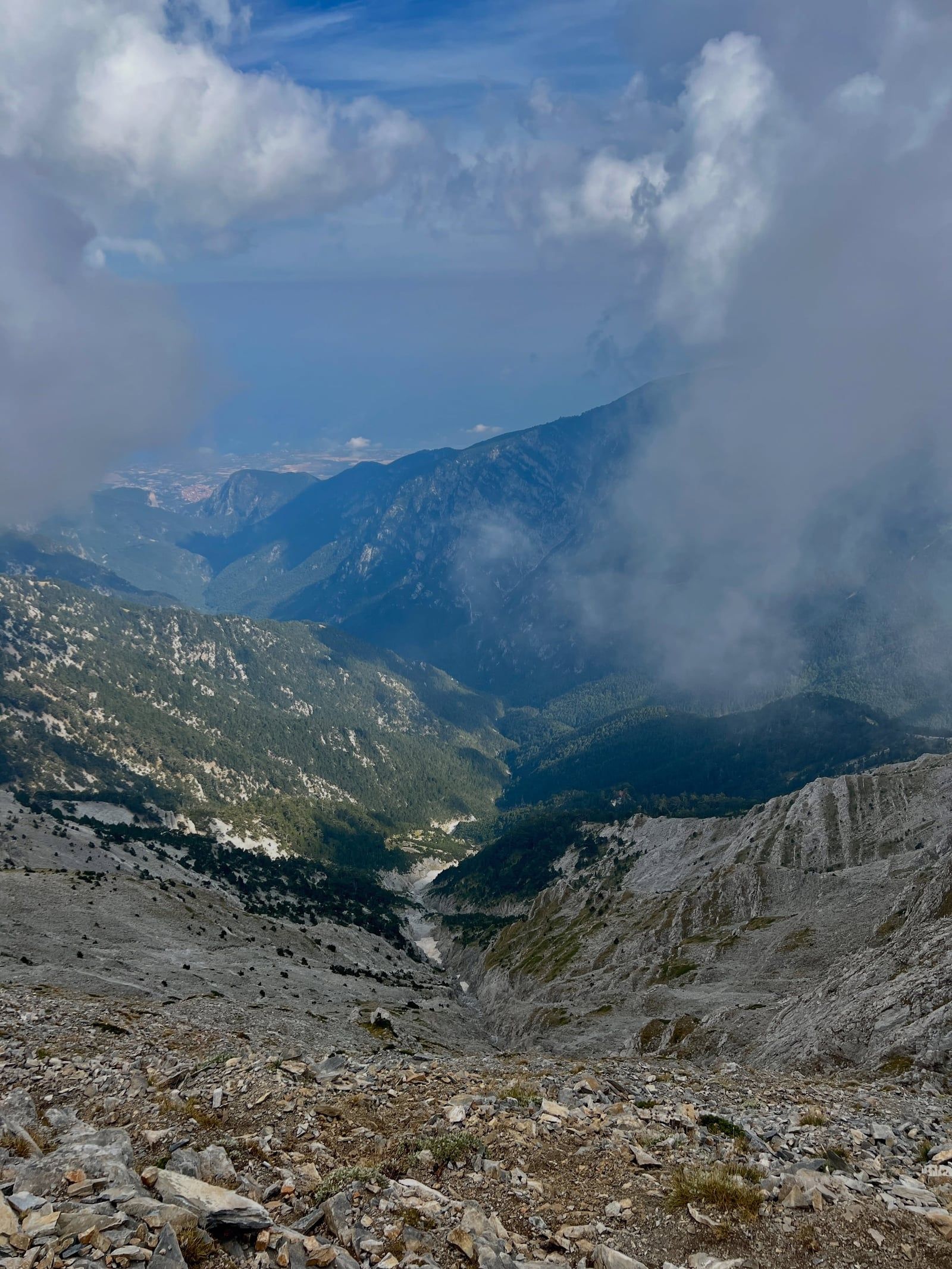
Olympus is a compact giant: 52 peaks in one massif, split by deep gorges — Enipeas the longest and best known — with the summit of Mytikas crowning the whole block. The mountain stands 2,353 m above the land around it, and that prominence pays off at the top, where clear-day views sweep the Thermaic Gulf, the Pieria coastline and the open Aegean. The rock underfoot is sedimentary rather than granite, which is why the final scramble is over smooth, polished stone instead of rough crags. Ice age glaciers left the cirques and gullies that now funnel trails toward the summit ridges.
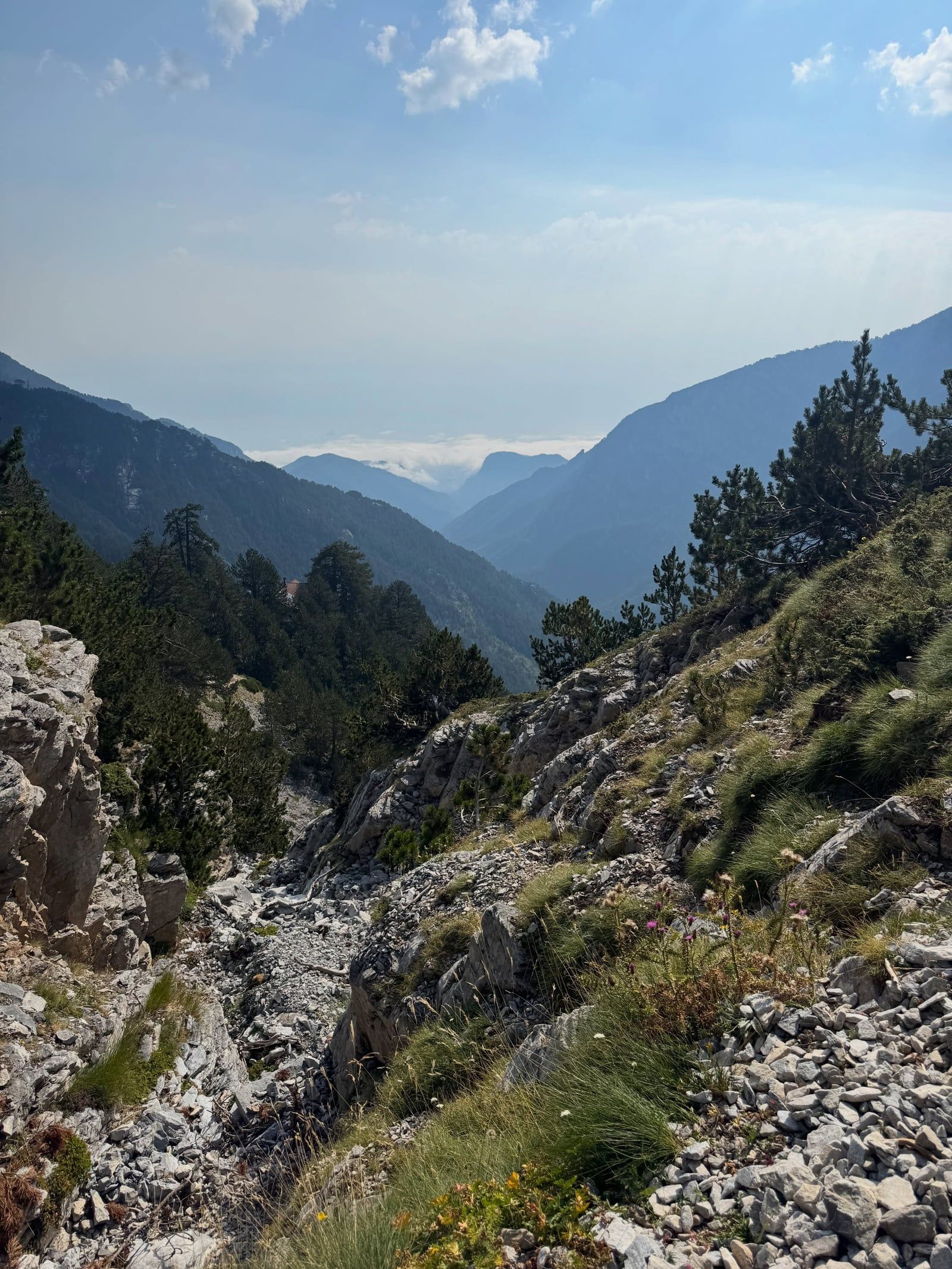
Vegetation stacks in bands as you climb. Mediterranean woodland at the base gives way to beech, fir and black pine; Bosnian pine takes over higher up; above roughly 2,500 m the trees stop and you're on bare alpine ground. Between about 600 m and the summit, the park's 24,000-hectare core zone holds around 1,700 plant species and subspecies — about a quarter of all Greek flora — among them the endemic Jankaea heldreichii, which grows on Olympus and nowhere else.
Wolves, jackals, chamois, roe deer, wild boar and wildcats live on the slopes, with more than 100 bird species overhead, golden eagles and peregrine falcons included. Mostly you'll hear them, not see them. The human geography is thin by design. A paved 18 km road climbs from Litochoro to Prionia at 1,100 m, the highest point reachable by car, and from there a 4.5 km forest trail, about three hours for most walkers, runs up to Refuge A at 2,100 m. Above it waits the Plateau of the Muses at roughly 2,650–2,700 m, two more refuges, and the start of the final scramble to the top.
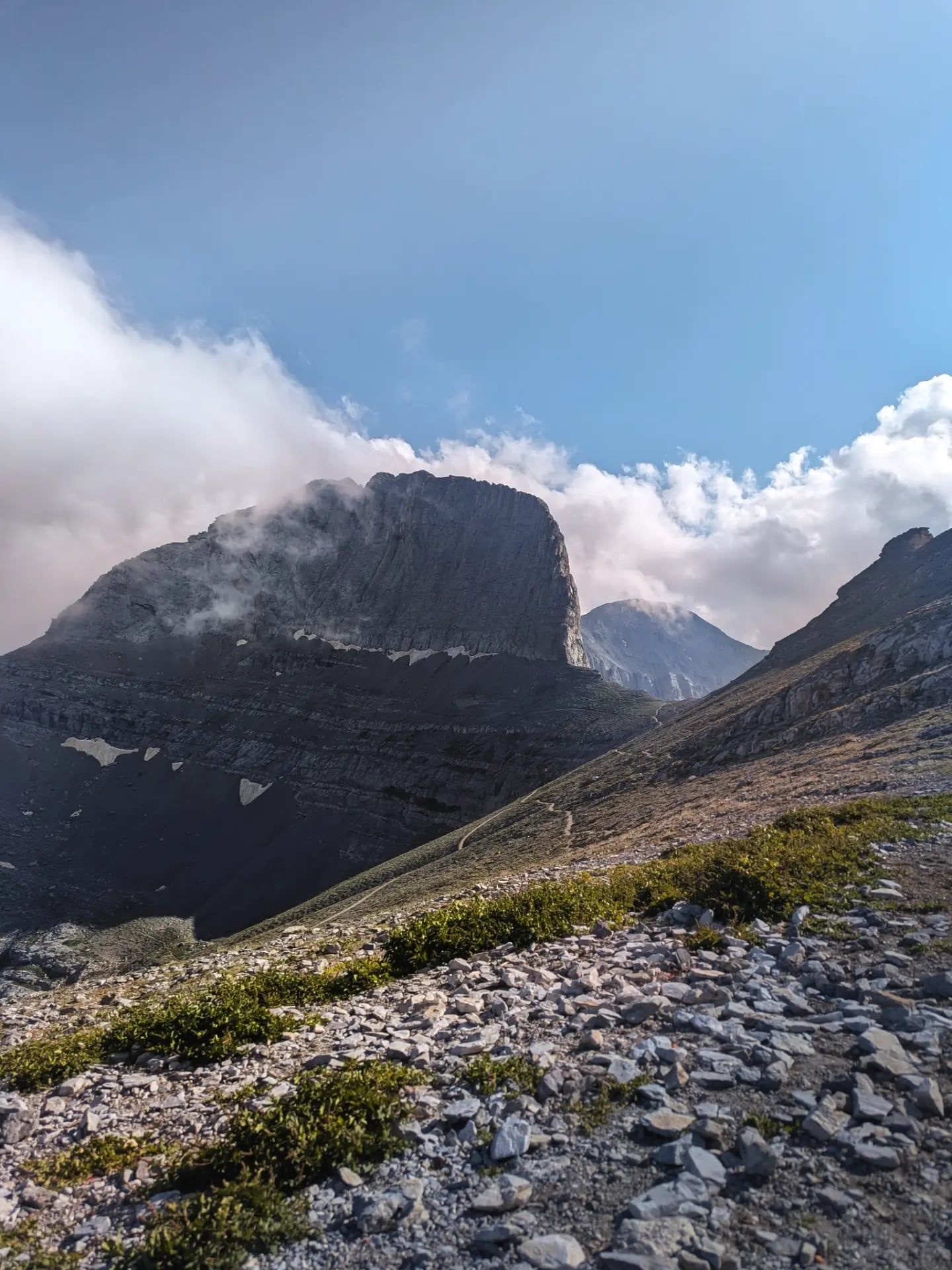
Zeus ruled here, the Greeks believed, and the twelve Olympian gods held council on the summit they called Pantheon. Climbers in 1921 named the rock fin of Stefani (2,909 m) the Throne of Zeus; the high basin below it became the Plateau of the Muses, home in myth to the nine sister goddesses of art and song. Homer described the mountain's 'mysterious folds', and the phrase still fits — on many evenings cloud pours over Stefani's summit and down toward the sea.
Worship happened at the bottom, not the top. Dion, the sacred city of the Macedonians, stood on the coastal plain at the mountain's foot, and its excavated sanctuaries, Hellenistic theatre and mosaics are open to visitors today — the museum next door displays an ancient hydraulis, a water-powered organ, recovered from the site. Standing among the ruins with the summit directly overhead, the old arrangement makes sense: the god got a city, and the mountain was left alone.
The mountain still organises life around it. Litochoro runs on hikers — its taxi drivers shuttle them to Prionia, its Information Center (daily 09:00–16:00) briefs them, and its guides take first-timers up the Mytikas scramble. One of the high refuges carries the name of Christos Kakkalos, the hunter who first stood on the summit in 1913. Access costs nothing, which suits a mountain of the gods better than a turnstile would.
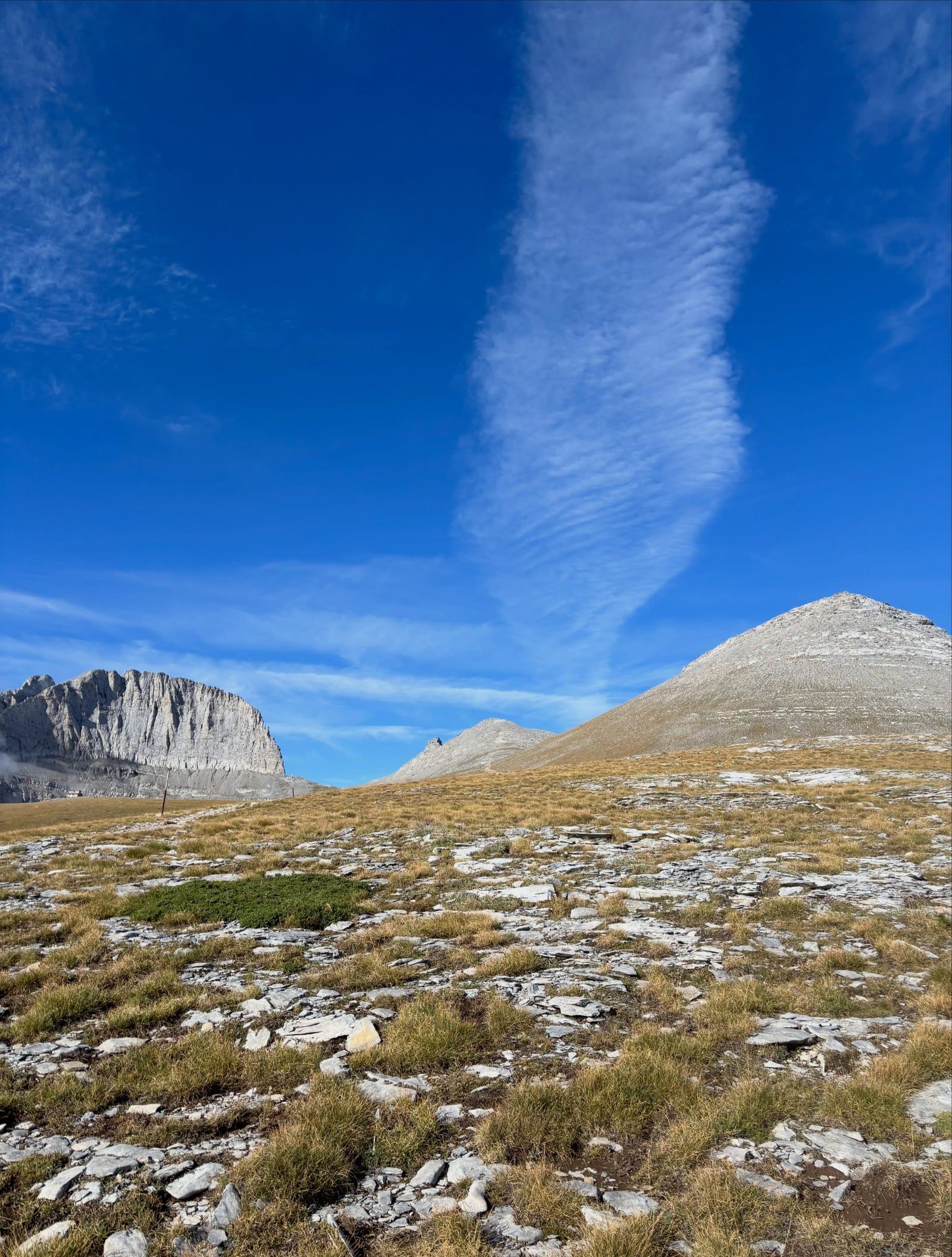
Ancient Greeks called Mytikas 'Pantheon', the meeting place of the deities, and built nothing on it — worship happened at the city of Dion at the mountain's foot.
The first recorded ascent of Mytikas, on 2 August 1913 at 10:25 am, was led by Christos Kakkalos, a Litochoro hunter guiding two Swiss climbers. He became the mountain's first official guide in 1932.
Olympus's slopes hold around 1,700 plant species and subspecies — about a quarter of all Greek flora — including the endemic Jankaea heldreichii, found nowhere else on earth.
An 18 km paved road climbs from Litochoro to Prionia at 1,100 m, the highest point on the mountain reachable by car and the usual trailhead for summit attempts.
The national park is free and open to the public at all hours. You pay only for services: refuge beds, and the Dion Archaeological Park (€10 full / €5 reduced).
The rock fin of Stefani (2,909 m) got its name — the Throne of Zeus — from climbers in 1921. Evening clouds streaming over its summit make it the mountain's most photogenic silhouette.
The beaches of the Olympus Riviera sit 5 to 20 minutes by car from Litochoro, so hikers can climb in the morning and swim in the Aegean the same afternoon, with the massif overhead.
No. The mountain and national park are free and open to the public at all times — there is no gate or ticket. You only pay for services: €18 per bed at Refuge A (€10 for children up to 13) and €10 full / €5 reduced at the Dion Archaeological Park & Museum.
Yes, if you're fit. Start from Prionia at 7:00 or earlier with a headlamp, reach Refuge A in roughly 2.5 hours, allow about 2 more hours to the Skala col, then do the final scramble — a 10–12 hour round trip. Most hikers prefer the two-day version with a night at Refuge A at 2,100 m.
It's an exposed scramble over smooth, loose rock from the Skala col, and it's the section where falls happen. A local guide is recommended for first-timers, and it should never be attempted in rain, fog or on ice. Guides and mountain offices in Litochoro can arrange it.
June to September, when trails are snow-free and the refuges are open. July and August bring sudden afternoon thunderstorms, so start summit days early. September is the pick: mild temperatures, clear air and fewer hikers on the trails.
The Hellenic Train service runs roughly hourly from Thessaloniki to Litochoro for about €9, taking around 1 hour 10 minutes — the station is 6 km from the village, a 5-minute taxi hop. The KTEL bus via Katerini costs about €10 and takes 2 hours 15 minutes. Driving covers the 92 km in about 1.5 hours on the A1/E75.
Refuge A (Spilios Agapitos) at 2,100 m is the main stop, with 110 sleeping places — book by phone at (+30) 23520 81800 or via the online reservation form, noting that weekends and groups require a deposit. Higher up, the Giosos Apostolidis (2,697 m) and Christos Kakkalos refuges sit on the Plateau of the Muses. Free camping is banned inside the park.
At least 2 litres of water per person for the Prionia–Refuge A climb, plus waterproofs, warm layers, a headlamp, hiking boots and high-carbohydrate snacks. Pack a sleeping-bag liner and slippers too: the refuge provides three blankets and a pillow but no sheets, and everyone must change into indoor shoes on entering.
Yes. UNESCO designated it a Biosphere Reserve in 1981, and on 26 July 2026, during the 48th session of the World Heritage Committee in Busan, it was inscribed on the World Heritage List as a mixed cultural and natural site.
Very. By early November the upper mountain is in full winter condition, requiring crampons, ice axe and rope, with avalanche danger on the steep snow-filled gullies. The high refuges close in late October, and winter ascents are for experienced, properly equipped mountaineers only.
Partly. The Enipeas Gorge walk and the Prionia area suit families, park rules require supervision, and Refuge A charges children up to 13 just €10 per night. The exposed final scramble to Mytikas is not appropriate for children — turn around at Skala or the Plateau of the Muses instead.
Browse verified tours with free cancellation and instant confirmation.
Find Tours